
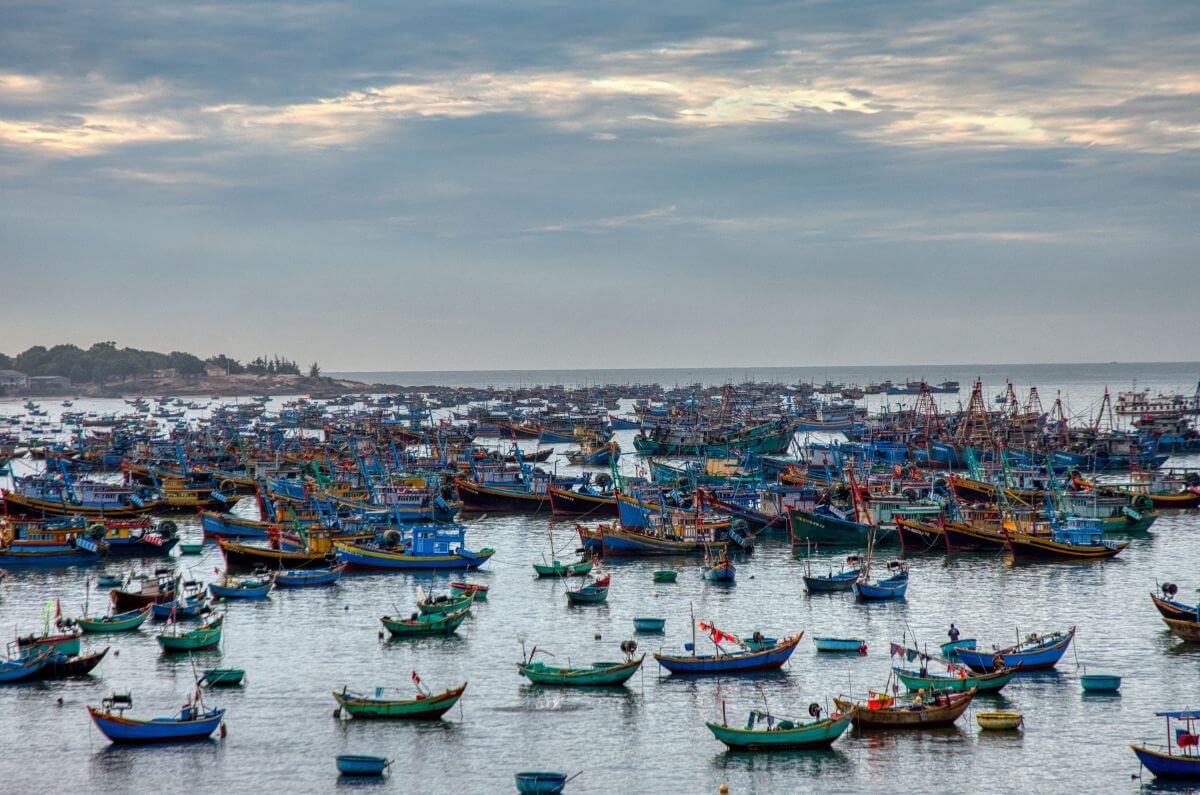
The South China Sea (SCS) is one of the world’s most strategically vital maritime regions. It is also one of the most contested regions, where overlapping territorial claims, abundant natural resources, and critical trade routes converge to create a complex web of geopolitical tensions. Spanning 1.4 million square miles of ocean, it is claimed in part by Brunei, China, Indonesia, Malaysia, the Philippines, Taiwan, and Vietnam.
The SCS is both a biodiversity hotspot and a crucial economic artery, carrying one-third of global trade flows each year. However, beneath this surface of economic prosperity and ecological richness lies an escalating crisis driven by the militarization of fishing industries, destructive artificial island-building campaigns, and the systematic diversion of environmental protection resources toward territorial enforcement.
This explainer examines how resource competition, territorial disputes, and weak regional governance are creating a destructive feedback loop that simultaneously threatens marine ecosystems, undermines human security, and destabilizes one of the world’s most important maritime regions.
SCS-101: Claims, Corals, Commodities, and Commerce
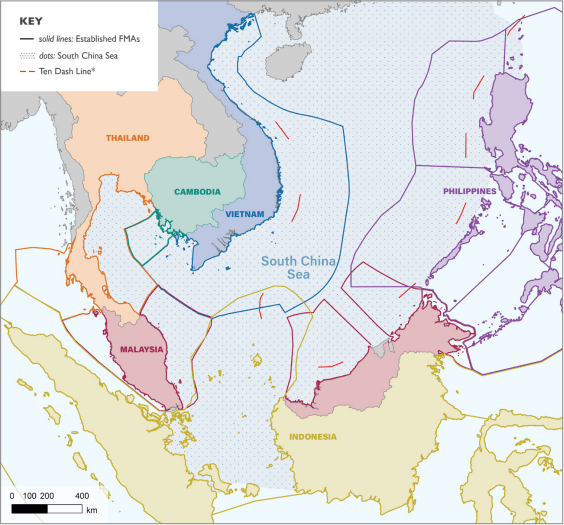
Claims: The SCS is claimed in whole or in part by seven coastal states, creating a patchwork of overlapping boundaries and exclusive economic zones (EEZs).1The United Nations Convention on the Law of the Sea (UNCLOS, 1994) regulates sovereign rights over coastal states in specific maritime zones including territorial seas, 200-nautical-mile EEZs, and the high seas2Govella, Kristi, “Avoiding and exploiting the tragedy of the commons: fishing, crime, and conflict in the South China Sea,” International Politics 60, No. 6 (2023): 1294–1314, doi:10.1057/s41311-023-00501-4. While some states rely on the United Nations Convention on the Law of the Sea (UNCLOS) for their maritime claims, others base claims on historical rights. China’s nine-dash line and Taiwan’s eleven-dash line, based on historical claims made by the Republic of China in 1947, encompass 62% of the SCS, and overlap with the EEZs of Brunei, Indonesia, Malaysia, the Philippines, and Vietnam.3Ibid. These fragmented and conflicting legal and historical frameworks have led to disputes over key features including the Paracel Islands, the Spratly Islands, and Scarborough Shoal.4“Territorial Disputes in the South China Sea,” Center for Preventative Action, September 17, 2024. https://www.cfr.org/global-conflict-tracker/conflict/territorial-disputes-south-china-sea.
Corals: The seascape is a biodiversity hotspot, home to 22% of the world’s known fish species and 571 of 1,683 reef-forming coral species.5Pauly, D. and Liang, C. The fisheries of the South China Sea: Major trends since 1950. Marine Policy 121, (2020). https://doi.org/10.1016/j.marpol.2019.103584.6Huang, D. et al., “Extraordinary diversity of reef corals in the South China Sea,” Mar Biodiv 45, (2015): 157-168, https://doi.org/10.1007/s12526-014-0236-1. Reefs provide food and shelter for 3,790 species of fish in the SCS and eight of the world’s ten species of giant clam.7Ibid.8Monica Sato et al.,“Deep Blue Scars: Environmental Threats to the South China Sea,” the Center for Strategic and International Studies, 18 December 2023, https://features.csis.org/environmental-threats-to-the-south-chinasea/#:~:text=About%2022%20percent%20of%20the,tuna%2C%20also%20traverse%20the%20area. Decades of overfishing, habitat destruction, and environmental degradation have had devastating impacts on coral reefs and fish stocks. Coral reef cover is declining 16% per decade, while fish stocks have experienced a staggering 70%-95% decline since the 1950s.9Gregory B. Poling, Illuminating the South China Sea’s Dark Fishing Fleets,” the Center for Strategic and International Studies, (2019). https://ocean.csis.org/spotlights/illuminating-the-south-china-seas-dark-fishing-fleets/.10Pauly, D., “The fisheries of the South China Sea.”
Commodities: The seascape holds vast energy and fisheries resources.11Benjamin J. Sacks, “The Political Geography of the South China Sea Disputes,” RAND Corporation, (2022). https://www.rand.org/content/dam/rand/pubs/perspectives/PEA2000/PEA2021-1/RAND_PEA2021-1.pdf. Beneath it lie an estimated 11 billion barrels of oil and 190 trillion cubic feet of natural gas, with Malaysia (27.9 tcf), China (5.7 tcf), and Vietnam (2.3 tcf) leading in proved and probable reserves.12Government of the United States of America, U.S. Energy Information Administration, “Regional Analysis Brief: South China Sea,” (Washington, D.C.: 2024). https://www.eia.gov/international/content/analysis/regions_of_interest/South_China_Sea/south_china_sea.pdf. Home to vast and diverse fish stocks that are consumed locally and exported to international markets, the SCS supplies 12% of global fish catch, valued at $11.34 billion annually. The industry directly employs 3.7 million people and supports the livelihoods of 190 million coastal residents.13Jianwei Li and Ramses Amer, “Closing the Net against IUU Fishing in the South China Sea: China’s Practice and Way Forward,” Journal of International Wildlife Law and Policy 18, no. 2 (2015): 139. https://doi.org/10.1080/13880292.2015.1044799 14U. Rashid Sumaila et al., “Sink or Swim: The Future of Fisheries in the East and South China Seas,” ADM Capital Foundation, (2021). https://www.admcf.org/wp-content/uploads/2021/11/Sink-or-Swim-Full-Report_171121.pdf..
Commerce: Beyond resources, the SCS is a critical artery for global trade: One-third of global trade transits through annually,15“Regional Analysis Brief: South China Sea.” including 45% of global crude oil shipments, 42% of propane shipments, and 26% of automotive shipments.16Srishti Chhaya, “The $5.3 Trillion Question: How South China Sea Tensions Are Rewriting Global Trade Rules,” Atlas Institute for International Affairs, July 4, 2025, https://atlasinstitute.org/the-5-3-trillion-question-how-south-china-sea-tensions-are-rewriting-global-trade-rules/ By trade value, China leads at $1.47 trillion, followed by Japan ($240 billion), Germany ($215 billion), and the United States ($208 billion).17“Regional Analysis Brief: South China Sea.”
What are the drivers of escalating tensions in the South China Sea?
The SCS exemplifies the “tragedy of the commons,” where shared and transboundary resources are depleted in the absence of effective governance and regional cooperation. In this complex environment, states pursue economic ambitions while using gray zone tactics to assert territorial control. States divert fishing fleets to contested waters, develop maritime militias, reclaim land, and militarize marine enforcement vessels, creating a feedback loop that deepens insecurity and accelerates environmental decline.
Investing in Overcapacity
Recognizing the outsized role of the fishing industry’s contributions to economic output in coastal states, governments in Southeast Asia spend $20 billion on fisheries subsidies each year through income guarantees, fuel tax exemptions, insurance schemes, and vessel modernization investments.18Anna Schuhbauer et al., ”The Global Fisheries Subsidies Divide Between Small- and Large-Scale Fisheries,” Frontiers in Marine Science 7, (2020). https://doi.org/10.3389/fmars.2020.539214 China allocates an estimated 96% of its fishing subsidies to the industrial fleet, while other Asian countries allocate on average 75% of their subsidies to the industrial fleet.
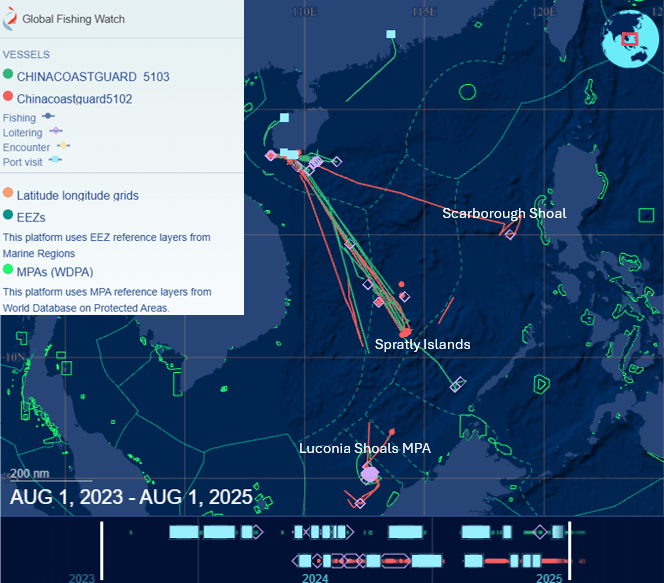
Excess fishing capacity in the SCS enables states to redirect their fisherfolk and vessels for strategic purposes, particularly in contested zones. The occupation of contested waters by fishing vessels, escorted by enforcement or military vessels, leads to frequent confrontations with neighboring claimants. Since 2022, the Philippines has filed 203 diplomatic protests against Chinese vessels and activities, adding to more than 350 protests filed between 2016 and 2022. 19Kurt Dela Peña, “West PH Sea: When diplomatic protests vs China fail” The Inquirer, March 14, 2025, https://www.inquirer.net/432091/west-ph-sea-when-diplomatic-protests-vs-china-fail/ By positioning large numbers of fishers around contested areas, states can assert primary control without direct military involvement.
To supplement their incomes, some fishers are recruited as part-time maritime militia. China and Vietnam maintain active maritime militias tasked with defending national sovereignty, escorting national fishing fleets, countering IUU fishing, and reinforcing territorial claims.20Nguyen The Phuong,“Vietnam’s Maritime Militia is not a Black Hole in the South China Sea,” Asia Maritime Transparency Initiative, May 22, 2020, https://amti.csis.org/vietnams-maritime-militia-is-not-a-black-hole-in-the-south-china-sea/.
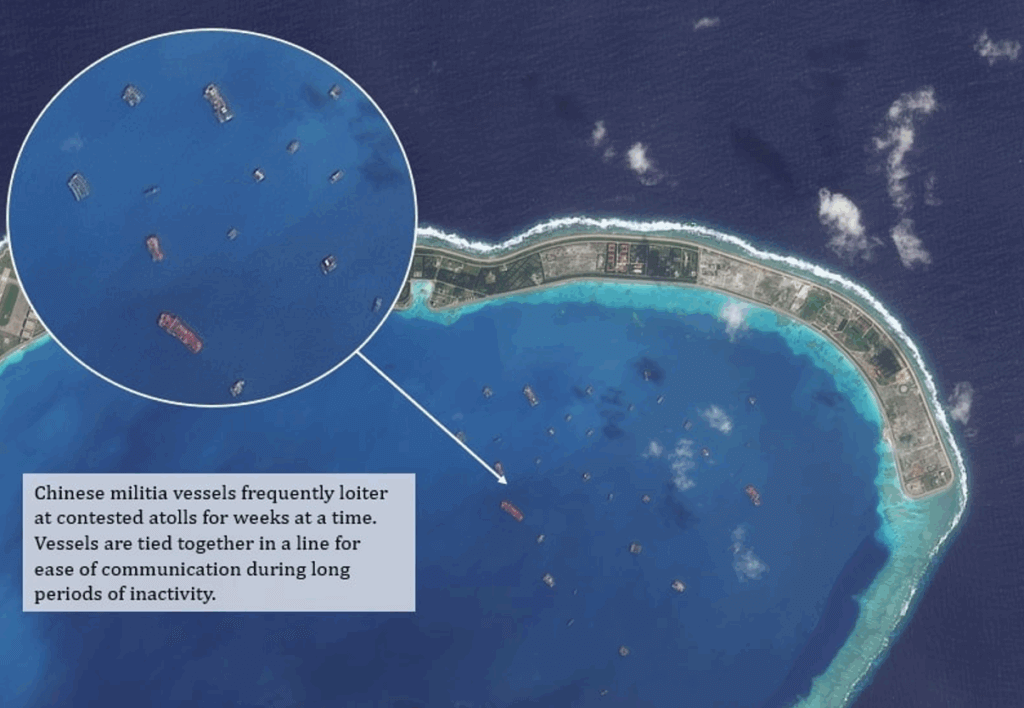
Satellite imagery courtesy of PlanetLabs. Methodology for identifying maritime militia vessels is courtesy of the Asia Maritime Transparency Institute.
Composed of civilian fishers recruited and trained by state or state-affiliated companies, maritime militias operate in a legal gray area: Under the law of naval warfare, vessels are protected from attack unless formally integrated into a combatant’s naval forces.21Shuxian Luo and Jonathan G. Panter, “China’s Maritime Militia and Fishing Fleets: A Primer for Operational Staffs and Tactical Leaders,” Military Review, (January–February 2021), https://www.armyupress.army.mil/Journals/Military-Review/English-Edition-Archives/January-February-2021/Panter-Maritime-Militia. Nearly 8,000 Vietnamese fishing vessels host militia units, and around the Spratly Islands, an estimated 300 Chinese militia vessels operate at any given moment.22Nguyen The Phuong, “Vietnam’s Maritime Militia.”23Gregory B. Poling et al., “Pulling Back the Curtain on China’s Maritime Militia.” The Center for Strategic and International Studies, November 2021, https://csis-website-prod.s3.amazonaws.com/s3fs-public/publication/211118_Poling_Maritime_Militia.pdf?VersionId=Y5iaJ4NT8eITSlAKTr.TWxtDHuLIq7wR By framing militia activities as private rather than state-directed, countries can advance territorial claims while sidestepping the economic, diplomatic, and political costs of direct military engagement.
Doubling Down on Island-Building
Malaysia, China, the Philippines, Taiwan, and Vietnam occupy approximately 70 disputed reefs and islets across the SCS.24Govella, Kristi, “Avoiding and exploiting the tragedy of the commons.” To reinforce their claims, these states have constructed more than 90 outposts on coastal and marine features through artificial island-building — dredging the seabed for sand and sediment and infilling it into designated areas to create land. Vice Minister of Foreign Affairs of China Hua Chunying has stated that these islands uphold territorial sovereignty, maritime rights, and economic activity.25Bonnie Glaser, “On the defensive? China explains the purposes of land reclamation in the South China Sea.” Asia Maritime Transparency Initiative, https://amti.csis.org/on-the-defensive-china-explains-purposes-of-land-reclamation-in-the-south-china-sea/. International concern has centered on Chinese island militarization, including installation of missile systems, laser and jamming equipment, and fighter jets on the Spratly Islands. These islands expand the geographic range of military activities, while surveillance infrastructure can provide critical data on claimant state activities in the seascape. Island-building does not confer legally binding territorial claims over the features but expands territorial control over features and the surrounding waters.
China and Vietnam have led island-building efforts in the region. Between 2013 and 2015, China created over 3,200 acres of artificial land across 27 outposts in the Paracel and Spratly Islands.26“China Island Tracker.” Asia Maritime Transparency Initiative, https://amti.csis.org/island-tracker/china/#Paracel%20Islands While Chinese activity has slowed since 2015, Vietnam has accelerated reclamation, adding about 2,360 acres in disputed areas since 2021. 27“Hanoi in High Gear: Vietnam’s Spratly Expansion Accelerates.” Asia Maritime Transparency Initiative, https://amti.csis.org/hanoi-in-high-gear-vietnams-spratly-expansion-accelerates/ Experts argue that Vietnam’s efforts provide leverage in military standoffs and help counter China’s disruptions of oil exploration and fishing.28Sam Beltran, “What Vietnam’s South China Sea island-building spree means for ASEAN,” South China Morning Post, August 27, 2025, https://www.scmp.com/week-asia/politics/article/3323262/what-vietnams-south-china-sea-island-building-spree-means-asean
Divesting from Ecosystem Protections and Monitoring
Fisheries enforcement vessels are crucial to ensuring fishing vessels comply with local, national, and regional fisheries management regulations. The UN Food and Agriculture Organization defines monitoring, control, and surveillance (MCS) of fishing fleets as the data collection, regulatory frameworks, and oversight needed for sustainability and compliance.29“Fishery Monitoring, Control, and Surveillance.” UN Food and Agriculture Organization, https://www.fao.org/4/y3427e/y3427e0a.htm. In the SCS, however, securitization has redirected MCS resources toward monitoring and interdicting military, paramilitary, and foreign fishing vessels in contested waters rather than patrolling and monitoring
inshore small-scale fishing zones and marine protected areas (MPAs), conducting vessel and gear
inspections, and spearheading collaborative investigations on IUU fishing in the seascape.
This diversion is evident in the “coastguardization” of militaries in the SCS. 30Govella, Kristi, “Avoiding and exploiting the tragedy of the commons.” Between 2010 and 2020, coast guard fleets grew by 73% in China, 62% in Malaysia, 103% in the Philippines, and 231% in Vietnam. Countries have struck maritime security agreements that further facilitate security patrol prioritization in contested waters. Since the start of the “Pivot to Asia” and the subsequent launch of the Indo-Pacific Strategy, allies of the QUAD have enhanced its military deployments through Freedom of Navigation Operations (FONOPs) in the SCS and invested heavily in security packages in the form of training programs, funding, and equipment transfers to bolster maritime security in the seascape.31Government of the United States of America, The White House, “Indo-Pacific Strategy of the United States,” (Washington, D.C.: 2022). https://bidenwhitehouse.archives.gov/wp-content/uploads/2022/02/U.S.-Indo-Pacific-Strategy.pdf 32Government of the United States of America, Department of Defense, “U.S. Department of Defense Vision Statement for a Prosperous and Secure Southeast Asia,” (Washington, D.C.: 2024). https://www.defense.gov/News/Releases/Release/Article/3973788/us-department-of-defense-vision-statement-for-a-prosperous-and-secure-southeast/ Meanwhile, states increasingly rely on navies and coast guards for fisheries enforcement as traditional funding for MPAs and fisheries management falls short. Over 60% of MPAs in the region report inadequate funding, with only 6% of UNFCCC funds dedicated to marine and coastal projects. 33“Financing the Ocean Back to Health in Southeast Asia: Approaches for Mainstreaming Blue Finance.” Asian Development Bank: Manila, Philippines. December 2021, https://www.adb.org/sites/default/files/publication/756686/financing-ocean-health-southeast-asia.pdf
Key informants34The Stimson Center has conducted extensive in-region interviews with stakeholders in the region as part of the Assessing IUU Fishing in Southeast Asia project. These findings are summarized in-depth in the IUU Fishing Risk Profile for the South China Sea. report that with MCS concentrated on interdiction offshore, foreign fishing vessels exploit perceived weak surveillance in neighboring EEZs.35Madelyn MacMurray et al, 2025, IUU Fishing Risk Profile for the South China Sea, The Stimson Center, Washington D.C., USA. As fish stocks decline, nations are caught in a destructive feedback loop: Territorial assertions and industry subsidies fuel “race-to-fish,” escalating security expenditures, industrial fishing, and aggressive territorial posturing.
What are the impacts of these strategic shifts?
The militarization of fishing fleets, expansion of coast guard operations, and prioritization of territorial control over environmental protection have led to far-reaching consequences across the SCS. These strategic shifts have fundamentally undermined regional cooperation, accelerated environmental destruction, and displaced millions of small-scale fishers who depend on increasingly depleted marine resources.
Constrained Cooperation
The SCS stands out among large cross-jurisdictional bodies of water with shared fisheries resources due to the absence of a multilateral mechanism for natural resource management. In the Caribbean, for example, the Western and Central Atlantic Fishery Commission coordinates conservation, management, and development across states.36“Western Central Atlantic Fishery Commission (WECAFC).” U.N. Food and Agriculture Organization of the United Nations, https://www.fao.org/wecafc/about/en/. Without a Regional Fisheries Body (RFB) or Regional Fisheries Management Organization (RFMO), there is very limited and fragmented scientific information on the status and conditions of the broader marine ecosystems within the SCS. Efforts to establish a sub-regional or ecosystem-specific RFMO have been hindered by a combination of factors, including industry disinterest, financial constraints37RFMOs require that member countries pay annual contributions to fund the RFMO’s budget. Due calculations vary between RFMOs but typically account for: a base fee, national wealth of the member state, variable fees based on total catch within the country’s EEZ, and discount factors for developing states., and distrust among the relevant coastal states.38Pomeroy, Robert & Parks, John & Courtney, Kitty & Mattich, Nives. (2016). Improving marine fisheries management in Southeast Asia: Results of a regional fisheries stakeholder analysis. Marine Policy. 65. 20-29. 10.1016/j.marpol.2015.12.002.
In the absence of an RFMO or RFB, states have pursued alternative avenues. The Southeast Asian Fisheries Development Center (SEAFDEC)39SEAFDEC membership is comprised of Brunei, Cambodia, Indonesia, Japan, Laos, Malaysia, Myanmar, the Philippines, Singapore, Thailand, and Vietnam. is an example of an effective formal multilateral institution, but its research is narrowly focused on biological research of pelagic fish species.40“SEAFDEC.” Southeast Asian Fisheries Development Center, http://www.seafdec.org/about/. The ASEAN Sectoral Working Group on Fisheries has made some notable strides such as establishing the ASEAN-Network (AN-IUU), a platform for reporting IUU fishing activities.41“ASEAN, EU Ramp Up Efforts to Fight Illegal Fishing,” Association of Southeast Asian Nations, 18 July 2024, https://asean.org/ asean-eu-ramp-up-efforts-to-fight-illegal-fishing/ The Regional Plan of Action to Promote Responsible Fishing Practices including Combatting IUU Fishing (RPOA-IUU)42RPOA-IUU membership is comprised of Australia, Brunei, Cambodia, Indonesia, Malaysia, Papua New Guinea, the Philippines, Singapore, Thailand, Timor-Leste, and Vietnam. is an intergovernmental organization that facilitates voluntary cooperation, information sharing, and technical collaboration across the Indo-Pacific, including the SCS.43“RPOA-IUU.” Regional Plan of Action for Combatting Illegal, Unreported, and Unregulated Fishing, https://rpoaiuu.org/about-us/. Yet the impact of these initiatives is limited. Participation is voluntary, and critical actors like China have shown little interest.44Govella, Kristi, “Avoiding and exploiting the tragedy of the commons.”
Legally binding agreements have proven even harder to reach. ASEAN members and China adopted Guidelines for Accelerating the Early Conclusion of an Effective and Substantive Code of Conducts in the South China Sea (CoC) in July 2023, but there has been little progress beyond the consolidation of drafts.45Shi Jiangtao, “Beijing declared milestone on South China Sea Code of Conduct. Is it progress or a tactic?” South China Morning Post, 8 April 2025, https://www.scmp.com/news/china/diplomacy/article/3305473/beijing-declared-milestone-south-china-sea-code-conduct-it-progress-or-tactic Disputes persist over enforcement, geographic scope, legal status, and the role of external powers, underscoring the difficulty of reaching consensus amid competing territorial claims and geopolitical tensions.
Environmental Degradation
Unsustainable extraction of marine resources has reduced the SCS’s fish stocks to just 5%-30% of their 1950s levels.46Daniel Pauly, “The fisheries of the South China Sea.” Effective fisheries management requires reliable data on fish migration, stock status, and catch rates, but in the absence of cooperation, data remains incomplete, and states prioritize self-interest over sustainability.
Environmental degradation is most severe in contested waters. Land reclamation and overfishing have devastated an area that once rivaled the Coral Triangle in biodiversity. Coral destruction from artificial island construction has erased 6,200 acres of corals, with another 16,553 acres lost to giant clam harvesting.47Carolyn Cowan, “Island-building and overfishing wreak destruction of South China Sea reefs.” Mongabay, 8 April 2024, https://news.mongabay.com/2024/04/island-building-and-overfishing-wreak-destruction-of-south-china-sea-reefs/. At the current rate of 16% decline per decade, 90% of reef ecosystems could vanish by 2050, eliminating key spawning grounds and disrupting the marine food web48E. Becatoros. 2017. More Than 90 Percent of World’s Coral Reefs Will Die by 2050. The Independent. 13 March.
As fishery productivity declines, targeting of endangered, threatened, and protected species has increased, driven by high prices on unregulated markets. Vessels exploit weak enforcement and encroach on MPAs across Cambodia, Indonesia, the Philippines, Thailand, and Vietnam.49MacMurray et al., “IUU Fishing Risk Profile for the South China Sea.” In the Philippines, only 34% percent of 564 examined MPAs improved fish biomass, underscoring widespread enforcement gaps.50Leilani Chavez,“With growing pressure, can the Philippines sustain its marine reserves?” Mongabay, 30 June 2021, https:// news.mongabay.com/2021/06/with-growing-pressures-can-the-philippines-sustain-its-marine-reserves/#:~:text=Coral%20 protection%20was%20the%20focus,government%20and%20the%20coastal%20community
Despite stagnant catch rates, rising fish demand pushes industrial vessels toward increasingly destructive methods and zone violations. Industrial trawlers regularly breach inshore exclusion zones meant to protect small-scale fishers, damaging seabeds, seagrass, and reefs.51MacMurray et al., “IUU Fishing Risk Profile for the South China Sea.” In Vietnam’s EEZ alone, trawlers account for 66% of 2,661 metric tons of fish caught annually.52Monica Sato et al., “Deep Blue Scars.”
Decades of stagnant total catch despite increasing fishing effort indicates severe stock overexploitation, with fishers “fishing down the food chain” — increasingly targeting smaller, less valuable species as higher trophic levels collapse. This trajectory signals systemic ecosystem breakdown driven by destructive practices and inadequate regional governance.
Human Security
Industrial fishing accounts for 75% of annual catch in the SCS, but small-scale fishers (SSFs) make up most of the region’s workforce. Of the 1.77 million vessels in the SCS, 86% are small-scale.53Due to difficulties monitoring SSF operations, this figure is almost certainly an undercount.54U. Rashid Sumaila and William W.L.
Cheung, “Boom or Bust: The Future of Fisheries in the South China Sea,” ADM Capital Foundation, 2 November 2015, https://www.admcf.org/research-reports/boom-or-bust-the-future-of-fish-in-the-south-china-sea. SSFs are often driven to engage in IUU fishing due to regulatory barriers, unclear boundaries, or subsistence needs, but their impact pales in comparison to that of industrial vessels.
The security tensions described in previous sections divert resources away from managing small-scale vessels and supporting livelihoods. Some countries have introduced exclusive zones and co-management systems, but low labor capacity, limited funding, a lack of standard operating procedures, and problems with coordination have undermined effectiveness. 55Michael Fabinyi et al., “Coastal Transitions: Small-scale fisheries, livelihoods, and maritime zone developments in Southeast Asia.” . Journal of Rural Studies. 91 (2022). 184-194. 10.1016/j.jrurstud.2022.02.006.56M. Fortnam et al. Polycentricity in practice: Marine governance transitions in Southeast Asia. Environmental Science & Policy 137 (2022), 1462-9011, https://doi.org/10.1016/j.envsci.2022.08.010. Enforcement is further hampered by a “pay to play” system in nearshore waters, where industrial fleets can pay bribes and buy exemptions to fish outside of designated zones.57MacMurray et al., “IUU Fishing Risk Profile for the South China Sea.” At the same time, securitization has led to restrictions prohibiting community access to ancestral fishing grounds in places like the Philippines and Vietnam. xlix Industrial development, sand mining, land reclamation, and tourism development are additional stressors, with coastal squeeze occurring across Southeast Asia. The economic toll is severe: In Indonesia, small-scale fishers fell from two million in 2000 to 966,000 in 2018, while in Cambodia, coastal dispossession and overfishing cut fishing incomes in half between 2019 and 2022.58Anna Zuzy,“Fishers are one of the poorest professions in Indonesia, yet they are one of the happiest,” The Conversation, 8 June 2020, https://theconversation.com/fishers-are-one-of-the-poorest-professions-in-indonesia-yet-they-are-one-of-thehappiest-139872
Declining viability has pushed many to migrate to cities or toward high-risk activities such as smuggling and IUU fishing.59Michael Fabinyi et al., “Coastal Transitions.” It has also fueled labor abuses: Falling profits drive reliance on cheap or forced labor, often among migrant workers who are at high risk of exploitation. By squeezing labor costs, vessels are able to offset profit losses in other areas.60Chris Eaton, “Fact Sheet: The Illegal Fishing and Forced Labor Prevention Act.” Greenpease, 13 May 2021, https://www.greenpeace.org/usa/fact-sheet-the-illegal-fishing-and-forced-labor-prevention-act/ Supported by supply ships, fishing vessels can remain at sea for months, operating beyond regulatory oversight. The ILO estimates that 128,000 fishers are trapped in forced labor aboard vessels, facing hazardous conditions, low pay, illness, physical injury, psychological and sexual abuse, and isolation.61This figure is likely an undercount given challenges associated with measuring forced labor and isolation at sea, which hinders the reporting of cases.62“Preventing forced labour at sea in Indonesia through labour inspections at Indonesian fishing ports.” International Labour Organization, 17 October 2022, https://www.ilo.org/resource/news/preventing-forced-labour-sea-indonesia-through-labour-inspections.
Conclusion
The South China Sea crisis illustrates how competing national interests, resource scarcity, and weak governance can fuel self-reinforcing cycles of environmental degradation and geopolitical instability. Fishing fleets have been transformed into tools of territorial assertion, military infrastructure has been prioritized over ecosystem protection, and the absence of effective multilateral management has produced a maritime tragedy of the commons. With fish stocks depleted to just 5%-30% of their 1950s levels, coral reef cover declining 16% per decade, and 90% of reef ecosystems projected to disappear by 2050, the ecological crisis threatens the livelihoods of 190 million people and the food security of coastal nations across the region.
The human toll is staggering: Small-scale fishers face displacement, economic marginalization, and exploitation in forced labor systems that thrive amid militarized competition and weak regulation. Without urgent action to establish effective regional fisheries management, restore ecosystems, and curb the weaponization of marine industries, the SCS risks becoming both an ecological wasteland and a lasting flashpoint for conflict. The stakes are high. The region’s future will show whether maritime disputes can be managed through cooperative governance or spiral into an intractable cycle of ecological collapse and geopolitical confrontation.
Acknowledgements
This piece synthesizes key findings from the Stimson Center’s Assessing IUU Fishing in Southeast Asia project. I am thankful to Carolyn Gruber, who provided substantial guidance on content and structure in this piece, and to Brian Eyler and Lauren Herzer-Risi for providing comments and edits on many earlier versions and drafts.









Community Adaptation for a Water Festival Without Clean Water